Lincoln is an investor and content marketer. He has worked for financial advisors, institutional investors, and a publicly-traded fintech company. Lincoln holds degrees in Finance, Economics, and Accounting.
OpenAI is not publicly traded, but accredited investors can still buy its stock.
Clarity (formerly Hiive) is a marketplace where accredited investors can buy shares of private companies before they go public.
Sign up with Clarity and get access to OpenAI stock before its IPO.
OpenAI is ranked as one of the top AI labs worldwide. As of February 2025, Elon Musk wanted to buy it — he led a bid to buy OpenAI for $97.4 Billion. The point? OpenAI is hot.
It has developed game-playing AI software that can beat humans at video games such as Dota 2, but it is best known for its AI text generator ChatGPT.
Before ChatGPT, OpenAI’s AI image generator (Dall-E) was the talk of the AI world.
OpenAI has raised the bar in terms of what we can expect from artificial intelligence. Its applications can create art, write essays, and develop computer programs better than most humans.
If you take a moment to think about the implications of such advanced AI, it might seem like OpenAI should be leading the charge when it comes to hot tech investments.
And it is, sort of.
Can You Invest in OpenAI Stock? Is OpenAI Publicly Traded?
Don’t bother searching for how to buy OpenAI stock or an OpenAI stock symbol because this company isn’t publicly traded.
OpenAI has a wonky business structure that includes both for-profit and nonprofit components, but one thing’s for sure: It’s not a public company.
Companies often choose to remain private if they do not need to raise capital via an IPO, or if they prefer to focus on their business development without the pressure of Wall Street.
Just because OpenAI shares are not available to purchase directly doesn’t mean that you can’t get exposure to the company. Let’s discuss.
How to Buy OpenAI as an Accredited Investor
OpenAI is not publicly traded, but accredited investors can invest in private companies including OpenAI through Clarity.

Clarity is a marketplace that connects shareholders of private, VC-backed companies who want to sell their pre-IPO shares to accredited investors.
With no buying fees, the ability to negotiate, and a robust marketplace with thousands of companies, Clarity is a great way to invest in companies before they IPO.
Sign up with Clarity, check out OpenAI, add it to your watchlist, and get notified about any new listings and trades.
Who Owns OpenAI?
It’s kind of complicated, but let’s do our best to explain.
In 2015, OpenAI was founded as a non-profit organization by Elon Musk and a few other partners. Musk left the company in 2018. By 2019, a for-profit company called OpenAI LP (LP stands for Limited Partnership) was created under the non-profit parent company, OpenAI Inc.
In early 2019, OpenAI LP received a $1 billion investment from Microsoft, which is by far the largest contribution from any company. GPT-3 is licensed exclusively to Microsoft and its Azure cloud service.
Amazon Web Services and Infosys also invested in OpenAI, but the amounts invested were not released.
What about Sam Altman?
Entrepreneur Sam Altman is probably the face you most associate with OpenAI. As both the CEO and an OpenAI co-founder, Mr. Altman plays a big role in running this company. You might have also seen the wild media reports when OpenAI’s board fired and rehired Altman, which shows just how significant he is to the brand.
Mr. Altman reportedly holds no direct equity in OpenAI, so we can’t say he owns the company.
As hinted above, OpenAI has a distinctive dual structure: since its October 2025 recapitalization, the nonprofit OpenAI Foundation controls the for-profit OpenAI Group PBC.
Besides Sam Altman, there are five other co-founders behind OpenAI, and the company has investments from the likes of Fidelity and Softbank.
Many companies have also made massive investments and partnerships with OpenAI, most notably Microsoft (NASDAQ: MSFT).
So, although we know several individuals and investors involved with OpenAI, it’s difficult to say that any one entity owns this company.
Does Microsoft Own OpenAI?
On January 23rd, 2023, Microsoft announced a new multiyear, multibillion-dollar investment with OpenAI. Microsoft declined to provide a specific dollar amount, but rumors indicate Microsoft was in talks to invest as much as $10 billion.
This deal marks the 3rd phase of the partnership between the 2 companies, following previous investments in 2019 and 2021.
Microsoft is the real winner in AI so far – here’s a recap of how well they’re doing:
- $1 billion investment in OpenAI in 2019
- Owns GitHub which released Copilot
- Dalle powers Bing Image Creator
- Valle produces an AI voice based on just 3 seconds of input
- GPT in Word, PowerPoint, Outlook, etc.
- GPT-powered Bing
- A roughly 27% stake in OpenAI Group PBC as of the October 2025 recapitalization
In short, Microsoft (NASDAQ: MSFT) is OpenAI’s mega supporter. Of course, Microsoft isn’t doing all of this investing without expecting something sweet in return.
As of OpenAI’s October 2025 recapitalization, Microsoft held roughly 27% of OpenAI Group PBC, and OpenAI software is a part of services like Bing, Azure, and Copilot.
However, that doesn’t mean Microsoft (NASDAQ: MSFT) owns OpenAI. Sure, Microsoft (NASDAQ: MSFT) is a big deal in OpenAI’s infrastructure, but the two companies remain separate.
If you’re looking to bet on the future of artificial intelligence in general, buying Microsoft is probably the best option.
How to Invest in OpenAI
Need more help finding great stocks to invest in?
With a Zen Investor subscription, you can save precious research time and let a 40+ year market veteran do the heavy lifting for you. For just $99 per year ($79 using links from this post), you get:
✅ Portfolio of up to 30 of the best stocks for the long haul, hand-selected by Steve Reitmeister, former editor-in-chief of Zacks.com with a 4-step process using WallStreetZen tools
✅ Monthly Commentary & Portfolio Updates
✅ Sell Alerts if the thesis changes
✅ Members Only Webinars
✅ 24/7 access to all the elements noted above
✅ Access to an archive of past trades and commentary.
If you’re looking up how to buy Open AI stock as a retail investor, you could either hope for an IPO or invest in companies tied to this brand.
True, you can’t get pure OpenAI stock exposure as a retail investor, but there are methods to put some capital in this company.
The “duh” idea for how to buy Open AI stock is to buy Microsoft (NASDAQ: MSFT).
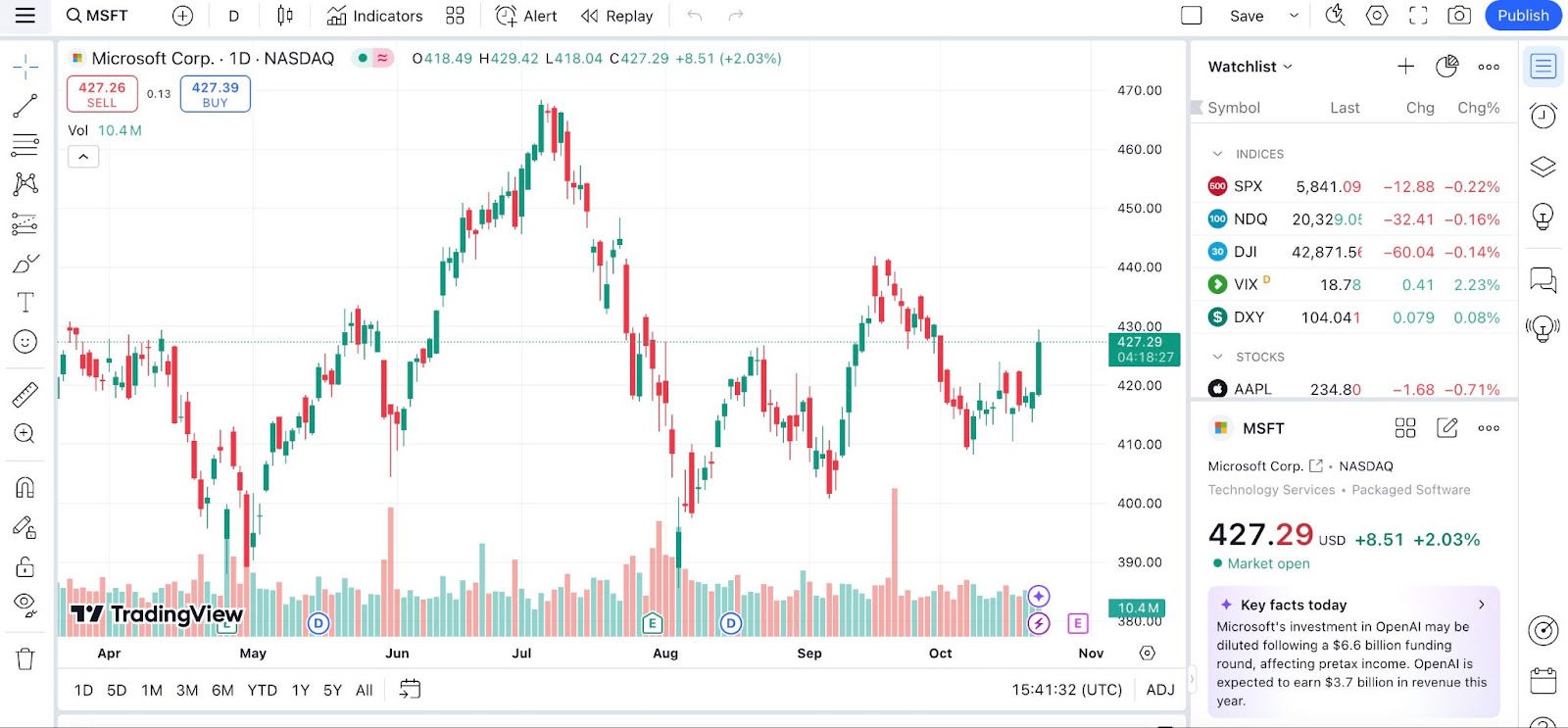
Chart courtesy TradingView
Microsoft doesn’t own OpenAI, but it’s the biggest investor in this company, and many of OpenAI’s programs run on Microsoft-owned properties like Bing.
If you’re more interested in the hardware powering OpenAI’s projects, Nvidia (NASDAQ: NVDA) is probably your best bet.
The AI chipmaker is an investor in OpenAI, and the language models OpenAI develops rely on Nvidia’s GPUs.
As a contrarian play, why not consider buying an OpenAI competitor?
Google (NASDAQ: GOOGL) is the first Big Tech company that comes to mind due to its AI integrations in search, including the chatbot Gemini. Google’s DeepMind is another one of the most advanced AI companies, with models that rival GPT-3. To bet on the industry as a whole, you may want to consider Alphabet (NASDAQ: GOOGL) (Google’s parent company).
You could also check out what former OpenAI member Elon Musk is doing at Tesla (NASDAQ: TSLA). True, Tesla (NASDAQ: TSLA) is better known for its stylish EVs, but it has put a heavier emphasis on AI initiatives like robotics and its Dojo system.
And if you can’t be bothered to invest in one single company? No sweat! You could invest in a tech-heavy fund like Invesco’s QQQ or an AI-focused ETF to get broad exposure to OpenAI’s niche.
For example, all GPT-3 models have been trained on Nvidia’s GPUs. Nvidia (NASDAQ: NVDA) has some of the most advanced hardware and software infrastructure for AI, so it’s likely that NVDA will increase in value as the industry progresses.
Finally, another option for retail investors is to invest in Fundrise’s Innovation Fund, which invests in a variety of high-growth companies. Currently, Open AI is among the companies in the fund. (Read more in our Fundrise Review)
Remember, if you decide to invest in Microsoft, Nvidia, or Google to gain exposure to OpenAI, these are massive companies with billions of dollars in revenue. When you invest in one of these companies, you’re buying more than just their Artificial Intelligence businesses, so be sure you like the ENTIRE company before choosing to invest.
More Required Reading: How to Invest in AI: Ultimate Guide
Note: We earn a commission for this endorsement of Fundrise.
You need a brokerage account to buy shares of the stocks mentioned above. If you don’t have one, we recommend eToro.
We reviewed 22 online stock brokerages and eToro came out on top. It is one of the world’s most popular investing platforms with over 30 million users.
Plus, as of November, eToro is offering a $10 bonus* for U.S. residents.
$10 bonus for a deposit of $100 or more. Only available to U.S. residents. New accounts only. Additional terms and conditions apply.
eToro securities trading is offered by eToro USA Securities, Inc. (“the BD”), member of FINRA and SIPC. Cryptocurrency is offered by eToro USA LLC (“the MSB”) (NMLS: 1769299) and is not FDIC or SIPC insured. Investing involves risk, and content is provided for educational purposes only, does not imply a recommendation, and is not a guarantee of future performance. https://www.wallstreetzen.com is not an affiliate and may be compensated if you access certain products or services offered by the MSB and/or the BD.
How to Buy the OpenAI IPO
OpenAI has been laying the groundwork for an IPO, but in September 2026, CEO Sam Altman said it would not go public in 2026. As a reminder, the nonprofit OpenAI Foundation controls the for-profit OpenAI Group PBC.
If they do decide to raise capital via an IPO, then OpenAI will become available via your brokerage or trading app.
Here are the steps on how to buy shares in OpenAI if and when they become available:
- Create or login to your brokerage account (if you don’t have one, we recommend eToro)
- Search for OpenAI
- Select how many shares you want to buy
- Place your order
- Monitor your trade
Remember, you cannot invest in OpenAI with any brokerage or trading platform at this time. The company is not currently on the market.
OpenAI Price Chart
On Clarity, there are currently 67 open orders for OpenAI (this number will shift constantly — check out the OpenAI listing on Clarity for the most up-to-date info), with an aggregate price as listed below:

However, a traditional “price chart” is a bit elusive compared to publicly-traded companies.
Here’s what we do know: The company started with a seed funding of $1 billion from Elon Musk and his partners, and its valuation has climbed with each private funding round since. Its most recent closed round, in March 2026, raised $122 billion at an $852 billion post-money valuation.
If they raise funds again, or file for an IPO, their valuation may be publicly released. Still, until they become publicly traded, there will not be a traditional price chart to view.
Conclusion
OpenAI is the overlord of AI innovation.
As services like ChatGPT become a part of modern life, it’s no wonder investors want to get their hands on OpenAI stock.
Any accredited investors looking into how to buy OpenAI stock could use Clarity to invest in shares today.
For retail investors, there’s no way to gain direct exposure to OpenAI stock.
Unless OpenAI announces an IPO, retail investors have to settle for public companies with close ties, competing AI brands, or tech-heavy ETFs.
Any views expressed here do not necessarily reflect the views of Clarity Capital Limited (“Clarity”) or any of its affiliates. This communication is for informational purposes only, and is not a recommendation, solicitation, or research report relating to any investment strategy or security. Private securities are speculative, illiquid, and involve the risk of loss. Not all private companies will experience an IPO or other liquidity event; past performance does not guarantee future results. WallStreetZen is not affiliated with Clarity and may be compensated for user activity resulting from readers clicking on Clarity affiliate links. Clarity Capital Limited, member FINRA/SIPC.
FAQs:
How to buy OpenAI shares?
There's no way for retail investors to buy OpenAI stock unless the company decides to go IPO. However, accredited investors could find how to buy OpenAI stock on Clarity (formerly Hiive).
How much is OpenAI stock?
OpenAI was valued at $852 billion in its March 2026 funding round. However, not enough financial data has been released to create an OpenAI price chart.
What is the OpenAI ticker symbol?
The OpenAI ticker symbol has not yet been released. If they decide to become public via an IPO, we’ll find out the ticker symbol at that time.
Who owns OpenAI?
OpenAI is privately owned. As of its October 2025 recapitalization, the nonprofit OpenAI Foundation held about 26% of the for-profit OpenAI Group PBC and Microsoft about 27%, with employees and other investors holding the rest. A number of venture capital firms have also invested.
Where to Invest $1,000 Right Now?
Did you know that stocks rated as "Buy" by the Top Analysts in WallStreetZen's database beat the S&P500 by 98.4% last year?
Our November report reveals the 3 "Strong Buy" stocks that market-beating analysts predict will outperform over the next year.